Helmut Froeyman 19.09.2024
The prize money in our Belgian summer tournaments has not been indexed for decades so that (foreign) professionals rarely play in them nowadays. 11 years ago, it was quite different, including 7 grandmasters in Open Gent 2013, see my blog article: Swiss Gambit. This is unfortunate for our young talents because playing against professionals is a necessary learning experience to improve. In other words, anyone with ambitions today to become an IM or stronger must go abroad to find the right opponents.
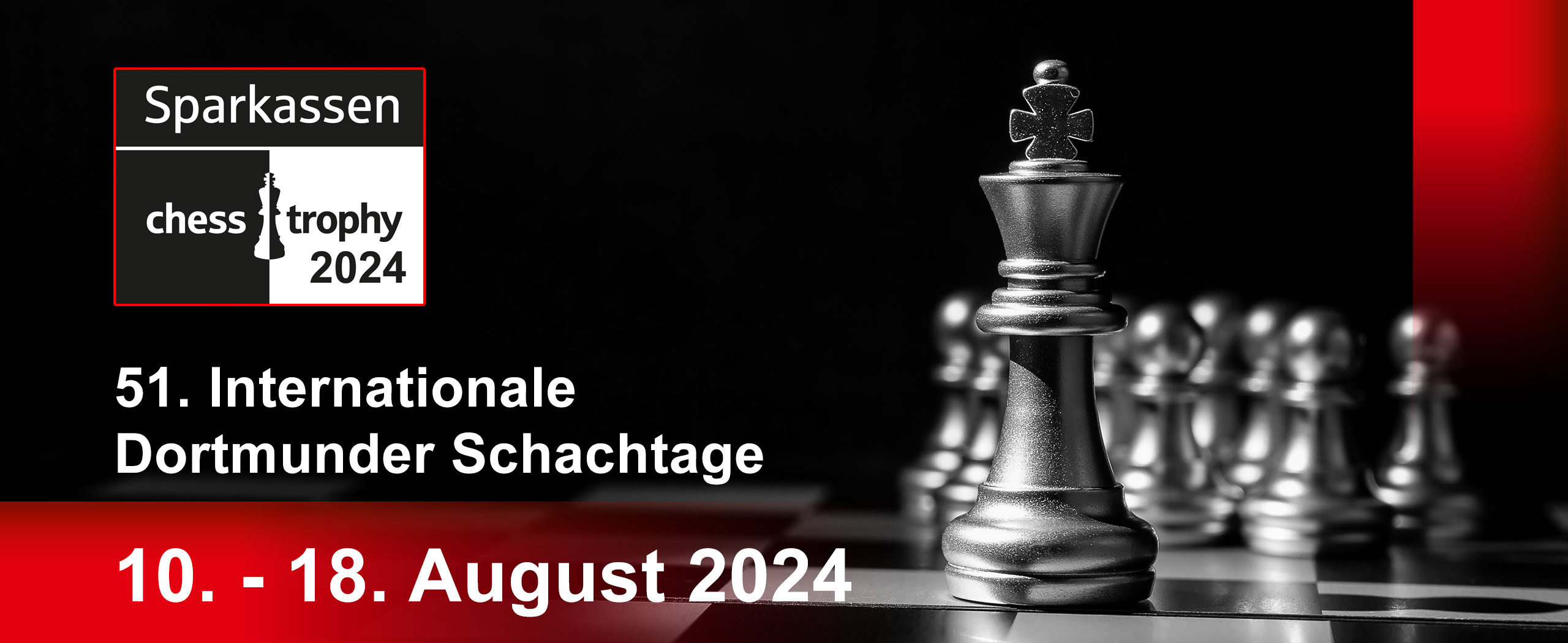
As a 48-year-old FM, I am naturally no longer one of those young wolves with sky-high ambitions, but I’m always happy to join a small tournament abroad. The previous two summers it was Dieppe (France), but that option came to an end last year due to the permanent discontinuation of the Deurne chess trips. So when I was invited by other chess friends this year to play in the Dortmund Sparkassen Chess Trophy in August, I gladly accepted.
Open Dortmund is a top tournament in Europe with a prize fund of 20,000 euros. 13 grandmasters participated in this edition. With my 2252 FIDE rating, I was only 44th in starting rank. Nevertheless, here too we see that budgets are getting smaller. The prize money was reduced by 5000 euros compared to last year. There were only 3 +2600 rated players compared to 9 +2600 rated players last year. The new playing hall only had space for half of the players, meaning games had to be played in shifts. The B-group (-2000) played “in the morning, the A-group (+1900)” in the afternoon. That is particularly inconvenient when you go to a chess tournament with friends who don’t all have the same playing strength. It was ultimately also the main reason why my daughter dropped out of this tournament.
Dortmund (approximately 600,000 inhabitants) is a 3-hour drive from Antwerp (approximately 100km from the Belgian border). The tournament organization offered the Intercityhotel as relatively cheap accommodation (single room with air conditioning and a nice breakfast for 87 euros/night). Parking was free, or at least we didn’t pay for it. Moreover, the hotel price also included a ticket for unlimited public transport in Dortmund. Dortmund clearly focuses on green initiatives, like more and more German cities. The latter was very interesting because every day I took the tram to commute from the hotel to the tournament hall and back. There was one every 10 minutes, and the ride took about 15 minutes.
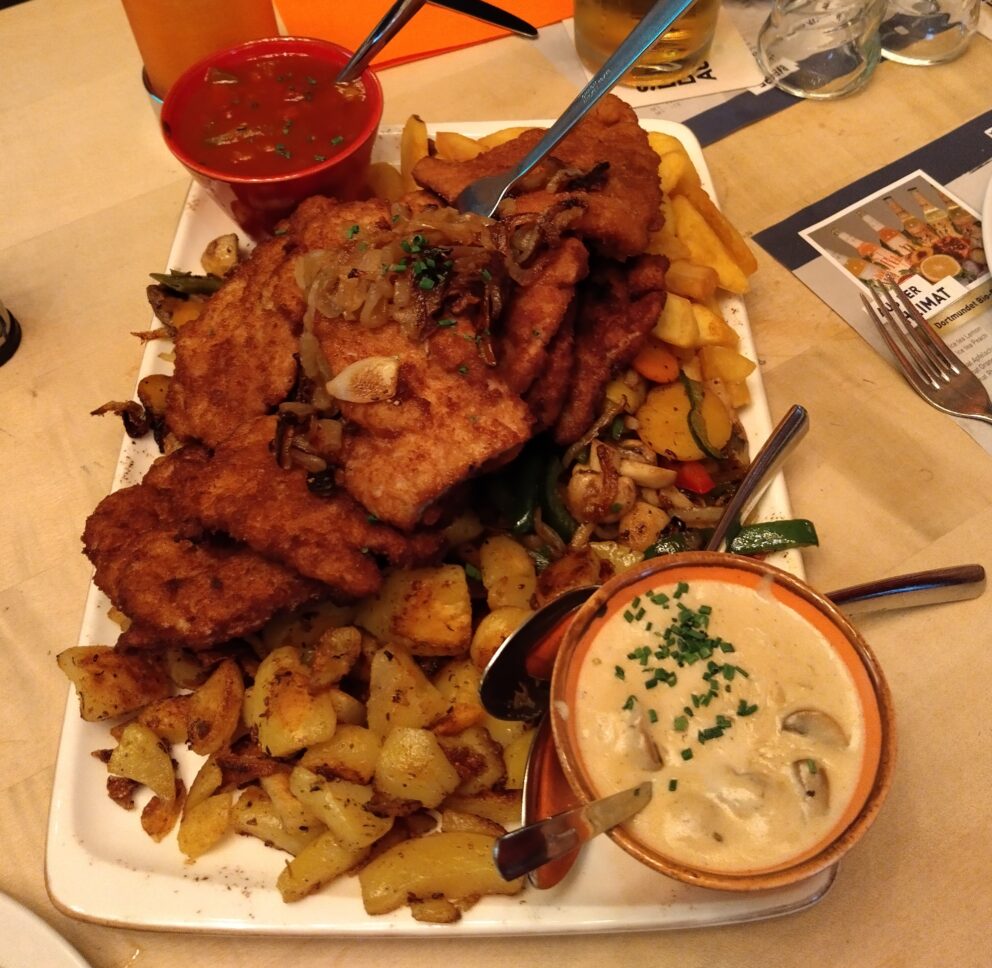
I didn’t have time to visit any sights, which I regretted. For instance, for 18 euros, I could have attended a Dortmund friendly football match during the tournament. Dortmund is all about football, and the city fills with colorful supporters whenever the local team plays. They also have a very strong team (yes, painful yesterday for Club Brugge who lost 0-3). Dortmund even has its own football museum. The Technology Museum with numerous interactive and discovery spaces is absolutely worth it. In the city center, there are many picturesque squares with nice restaurants and bars. During the tournament, there was a very well-attended Street Food & Beach Festival with music performances. We didn’t have a guesthouse, but eating and drinking, even late at night, was never a problem. TripAdvisor never failed to guide us to delicious and affordable meals at Thai, Italian, Spanish, Vietnamese, etc. On the last evening, we chose a Dortmund football pub with traditional local cuisine.
Nevertheless, I strongly doubt whether we will return in the future. There were several serious downsides to it. For example, there was no air conditioning in the tournament hall, and we had to play during the heatwave at temperatures around 35 degrees Celsius. I suspect they ran out of money because many professional players (including some women) received free accommodation, but that’s no excuse. However, what I find even more distressing is that the city center in Dortmund is overrun by drug users and alcoholics. We saw people snorting lines on the street. Broken glass from bottles was everywhere. You couldn’t sit on a terrace without being harassed for money. Germany is facing a gigantic social problem, see also 13,844 stabbing incidents reported in 1 year, because it’s certainly not just Dortmund. I saw the same in Berlin and Hamburg last year.
The tournament was strongly contested, and I didn’t play badly, but not well enough to overcome the fluctuations between stronger and weaker opponents. My score from rounds 2 to 8 was therefore 1-0-1-0-1-0-1. I had the ‘misfortune’ of always having black against the stronger opponents, and then DWZ was also used for my weaker opponents. DWZ is the German national rating, and it is usually significantly higher than FIDE. I find it absurd to mix DWZ and FIDE in pairings (some Belgian organizers dare to make the same mistake).
I’ll conclude with perhaps my most spectacular game of the tournament. It’s a game I lost in the third round against a young German FM with a 2400 Elo rating: Moritz Weishaeutel. It demonstrates how modern neural networks, even at this modest level, create opening analyses of incredible depth and danger. Moritz’s finish is spectacular and demonstrates sharp tactical insight.
Helmut Froeyman